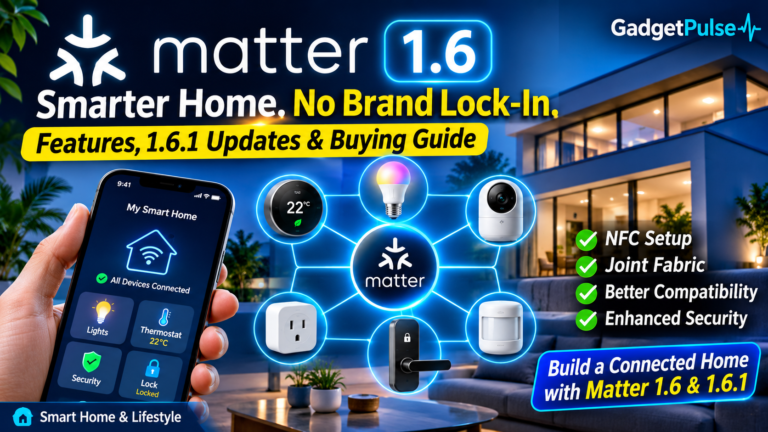

Imagine controlling smart lights, door locks, sensors and other connected devices from one smart home platform, even when they come from different manufacturers.
That is the idea behind Matter, a smart home connectivity standard designed to make devices from different brands work together more easily.
For years, smart home buyers have faced a common problem: a device that works with one ecosystem may not work properly with another. Some products require separate apps, additional hubs or specific voice assistants.
Matter aims to reduce these compatibility problems by creating a common standard for supported smart home devices.
But what exactly is Matter? Does it replace Wi-Fi, Bluetooth or Zigbee? Do you need a separate hub? And should you look for Matter support when buying smart home products in 2026?
Let’s understand everything in this detailed guide.
What Is Matter Smart Home Technology?
Matter is an open smart home connectivity standard developed by the Connectivity Standards Alliance (CSA).
Its main purpose is to improve compatibility between smart home products from different manufacturers and major smart home platforms.
For example, a Matter-compatible smart bulb may be controlled through supported platforms such as:
- Apple Home
- Google Home
- Amazon Alexa
- Samsung SmartThings
Actual compatibility depends on the device category, software version and platform support.
Matter is not a smart home app, a voice assistant or a wireless network. It is a common communication standard that helps compatible devices and platforms understand and control one another.
The Matter logo on a product indicates that it has been certified for the standard.
Why Was Matter Introduced?
Before Matter became available, smart home manufacturers often developed products around their own ecosystems.
This created several problems for consumers.
1. Different Brands Used Different Ecosystems
A smart bulb from one manufacturer might work with one platform but not another.
Buyers had to check compatibility carefully before purchasing each new device.
2. Too Many Smart Home Apps
Some homes ended up using separate applications for smart bulbs, plugs, cameras, sensors and other accessories.
Managing everything became unnecessarily complicated.
3. Hub and Connectivity Confusion
Some smart home products required additional hubs or bridges to communicate with other devices.
This increased setup complexity and could add to the total purchase cost.
4. Limited Cross-Platform Control
Consumers sometimes had to choose a smart home ecosystem before purchasing their devices.
Matter was developed to improve interoperability and make supported products easier to integrate into different smart home platforms.
How Does Matter Work?
Matter allows compatible smart home devices to communicate using a common application-layer standard.
It operates over supported network technologies such as:
- Wi-Fi
- Thread
- Ethernet
Bluetooth Low Energy is commonly used during device commissioning and setup. It is not the main transport used for normal Matter device communication.
Here is a simplified example:
- You purchase a Matter-compatible smart bulb.
- You open a supported smart home application.
- You scan the Matter setup QR code or use the available pairing method.
- The application discovers and connects to the device.
- You assign the bulb to a room.
- You can control it through the supported smart home platform.
The exact setup steps depend on the device and platform.
The important advantage is that compatible devices can communicate through a shared standard instead of depending entirely on separate manufacturer-specific integrations.
Matter vs Wi-Fi vs Bluetooth vs Zigbee
Many buyers confuse Matter with Wi-Fi, Bluetooth and Zigbee. However, these technologies perform different roles.
| Technology | Main Purpose | Common Smart Home Use |
|---|---|---|
| Matter | Smart home interoperability standard | Connecting compatible devices and platforms |
| Wi-Fi | Wireless networking | Smart plugs, bulbs and other connected devices |
| Bluetooth LE | Short-range wireless communication and setup | Device commissioning |
| Thread | Low-power mesh networking | Sensors, switches and smart home accessories |
| Zigbee | Low-power wireless communication protocol | Smart lights, sensors and switches |
Matter does not simply replace all these technologies.
For example, a Matter-over-Thread sensor uses Thread for its network connection and Matter for standardised device communication.
Similarly, a Matter-over-Wi-Fi smart plug uses Wi-Fi for network connectivity.
Zigbee devices do not automatically become Matter devices. They generally need a compatible bridge that connects supported Zigbee devices to a Matter ecosystem.
Matter Over Wi-Fi vs Matter Over Thread
One of the most important buying decisions is understanding whether a Matter device uses Wi-Fi or Thread.
Matter Over Wi-Fi
These devices connect through your existing Wi-Fi network.
Common examples include compatible smart plugs, lights and other connected devices.
Advantages:
- Uses an existing home Wi-Fi network.
- May not require a separate Thread border router.
- Familiar setup for many smartphone users.
- Suitable for devices that have access to regular power.
Things to consider:
- Your Wi-Fi coverage matters.
- Too many connected devices may increase network management requirements.
- Battery-powered products may have different power-consumption characteristics.
Matter Over Thread
Thread is a low-power wireless mesh networking technology designed for connected devices.
It is particularly useful for certain battery-powered smart home accessories.
Advantages:
- Designed for low-power communication.
- Supports mesh networking.
- Can extend network coverage through compatible Thread devices.
- Useful for supported sensors and accessories.
Things to consider:
- A compatible Thread Border Router is required to connect Thread devices to the home network and smart home ecosystem.
- Not every smart speaker or smart home hub supports Thread.
- You must check the specifications of your existing equipment.
Do You Need a Matter Smart Home Hub?
Not every Matter device requires a separate, dedicated hub.
However, the requirement depends on the device’s connection type and the platform you use.
For example:
Matter over Wi-Fi: A compatible smart home controller and suitable home network are needed. A separate Thread Border Router is not required just for Wi-Fi connectivity.
Matter over Thread: You need a compatible Thread Border Router as part of your smart home setup.
A smart speaker, display, router or dedicated smart home hub may provide the required controller or Thread Border Router functionality, depending on the model.
Before buying a hub, check whether your existing devices already provide the required functionality.
This can help you avoid spending money on unnecessary hardware.
What Is Matter Multi-Admin?
One of Matter’s useful features is Multi-Admin.
It allows a compatible Matter device to be shared with more than one supported smart home platform.
For example, you may want to control a compatible smart light through Google Home while another household member uses Apple Home.
Multi-Admin is designed to make this possible without requiring the device to be completely disconnected from one platform before connecting it to another.
However, the feature does not guarantee that every advanced feature will be available in every application.
The supported controls and experience can vary by device and platform.
What Types of Smart Home Devices Support Matter?
Matter supports several smart home device categories, although availability and platform support can vary.
Examples include:
1. Smart Lights
Compatible smart bulbs and lighting products can be controlled through supported smart home platforms.
2. Smart Plugs
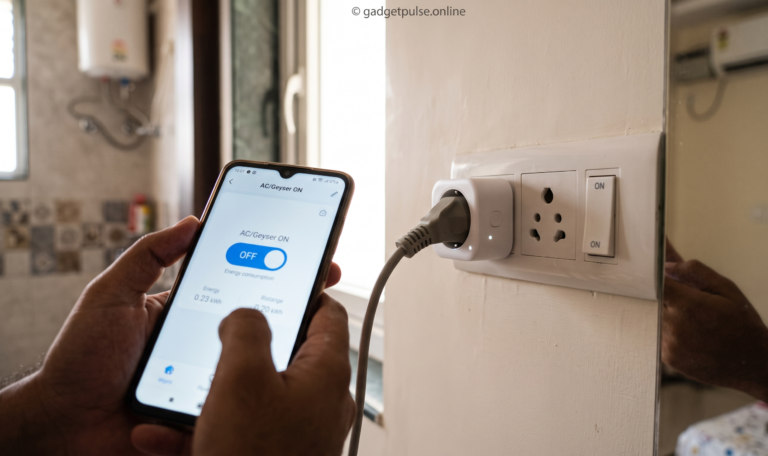
Matter-compatible smart plugs can help control supported electrical appliances through a connected smart home system.
Always check the electrical rating and safety certifications before connecting high-power appliances.
3. Smart Door Locks
Supported smart locks can integrate with compatible smart home platforms.
Because door locks are security-sensitive devices, check the manufacturer’s security information and supported features carefully.
4. Smart Sensors
Compatible motion, contact and other supported sensors can help trigger smart home automations.
5. Climate Controls
Supported thermostats and heating, ventilation and air-conditioning controls can be integrated into compatible systems.
Device availability varies by region and platform.
6. Window Coverings
Supported motorised blinds and window coverings can be controlled through compatible smart home applications.
The list of supported device types can expand as the Matter specification evolves.
Always check the latest certification and platform support information before purchasing.
Is Matter More Secure Than Traditional Smart Home Technology?
Security is an important part of Matter’s design.
The standard includes security mechanisms such as device authentication, encrypted communication and secure commissioning.
However, Matter certification does not mean that a device is completely immune to cyberattacks.
Your overall smart home security also depends on:
- The manufacturer’s software updates.
- Your Wi-Fi router security.
- Strong account passwords.
- Two-factor authentication where available.
- Secure smartphone and smart home applications.
- Properly configured home network access.
For better protection, purchase devices from manufacturers that provide regular security updates and clear privacy policies.
Do not assume that a Matter logo alone guarantees complete protection against every security risk.
Can Matter Devices Work Without the Internet?
This is one of the most interesting features of Matter.
Matter is designed to support local communication between compatible devices and controllers.
That means certain commands can continue working within your home network even when the internet connection is unavailable.
For example, a supported local smart home automation may continue operating without requiring every command to travel through a cloud server.
However, there are important limitations.
- Remote control from outside your home generally requires an internet-connected controller and an available connection.
- Some manufacturer-specific features may still depend on cloud services.
- Voice assistant functionality may require internet access.
- The behaviour of automations depends on the platform and device configuration.
Therefore, Matter can improve local smart home operation, but it does not make every smart home feature completely independent of the internet.
Matter vs Traditional Smart Home Devices
| Feature | Traditional Smart Home Devices | Matter-Compatible Devices |
|---|---|---|
| Cross-brand compatibility | Depends on manufacturer integrations | Designed for standardised interoperability |
| Setup | Can vary between brands | More consistent supported setup process |
| App support | May require manufacturer-specific apps | Can work with multiple supported platforms |
| Local communication | Depends on product design | Supports local network communication |
| Security | Depends on manufacturer and protocol | Includes standardised security mechanisms |
| Hub requirement | Varies | Depends on device and network technology |
Matter does not automatically make every device compatible with every platform. The exact device type and supported feature set still matter.
What Should You Check Before Buying a Matter Device?
Do not purchase a smart home product only because its packaging displays a Matter logo.
Check these important points before spending money.
1. Look for the Official Matter Logo
Check the product packaging and manufacturer’s official product page.
Make sure the exact model is Matter-certified. Do not assume that every product in a manufacturer’s product range supports Matter.
2. Check the Connection Type
Find out whether the product uses Matter over Wi-Fi or Matter over Thread.
If it uses Thread, check whether you already have a compatible Thread Border Router.
3. Check Smart Home Platform Compatibility
Confirm that the device category and required features are supported by your preferred platform.
4. Check Firmware and Software Requirements
Some products may require a specific firmware version, mobile application or operating system.
5. Check Advanced Features
Basic on/off control does not necessarily mean that every advanced feature will work across all platforms.
Check features such as brightness control, colour temperature, energy monitoring and automation support where relevant.
6. Check Manufacturer Support
Choose products from manufacturers that clearly explain their update policies, warranty terms and customer support options.
7. Check Local Availability
If you are purchasing in India, confirm that the exact model is available locally, has suitable electrical specifications and comes with valid warranty support.
Do not assume that a product sold in another country has identical specifications or support in India.
Is Matter Worth It for Indian Smart Homes in 2026?
Matter is worth considering if you are planning to build a smart home gradually or want more flexibility when choosing products from different manufacturers.
For Indian buyers, there are a few practical considerations.
Start with essential devices: Smart bulbs, compatible plugs and sensors can be useful starting points.
Check electrical compatibility: Always verify voltage, current rating, plug type and applicable safety certifications before buying electrical accessories.
Avoid unnecessary hubs: Check whether your existing smart speaker, display or router already supports the required Matter functionality.
Choose your ecosystem carefully: If you primarily use Android, Google Home may be a convenient starting point. If your household uses Apple devices, Apple Home may be more suitable. Amazon Alexa and Samsung SmartThings are other options, depending on device compatibility.
Check product availability: Not every Matter-certified device is necessarily sold or officially supported in India.
The most sensible approach is to buy products based on verified compatibility rather than assuming that all Matter devices work identically.
Final Verdict: Should You Choose Matter Smart Home Devices?
Matter is an important development in smart home technology because it aims to reduce compatibility problems between different manufacturers and platforms.
Its support for local communication, standardised setup and Multi-Admin functionality can make smart home management easier.
However, Matter is not a guarantee that every device will work with every smart home platform or support every advanced feature.
Before purchasing, check the certification, network technology, hub requirements, platform compatibility and manufacturer’s update policy.
If you are starting a new smart home in 2026, choosing well-supported Matter-compatible products can provide greater flexibility as your setup grows.
The best smart home is not necessarily the one with the most devices. It is the one where your devices work reliably together.
Frequently Asked Questions (FAQs)
1. What is Matter in smart home technology?
Matter is an open connectivity standard developed by the Connectivity Standards Alliance. It is designed to improve compatibility between supported smart home devices and platforms from different manufacturers.
2. Does Matter replace Wi-Fi?
No. Matter uses networking technologies such as Wi-Fi, Thread and Ethernet. It provides a common communication standard rather than replacing the underlying network.
3. Is Matter better than Zigbee?
They serve different roles. Matter is an interoperability standard, while Zigbee is a wireless communication protocol. Compatible bridges can connect supported Zigbee devices to Matter ecosystems.
4. Do Matter devices need a hub?
Not every Matter device needs a separate dedicated hub. However, a compatible smart home controller is required, and Matter-over-Thread devices also need a compatible Thread Border Router.
5. Can Matter work without the internet?
Matter supports local communication, so some devices and automations can work without an active internet connection. Remote access and cloud-dependent features may still require the internet.
6. Can I use Matter devices with Google Home and Apple Home?
Compatible Matter devices can be shared across supported platforms using Multi-Admin. However, supported device categories and features may vary.
7. Is Matter secure?
Matter includes security mechanisms such as authentication and encrypted communication. However, users should also maintain secure accounts, update device firmware and protect their home network.
8. Should I buy Matter-compatible smart plugs in India?
They can be a useful option, but check the exact model’s certification, electrical ratings, plug design, platform compatibility and local warranty before purchasing.
9. Does every smart home device support Matter?
No. Only products that support the standard can be used as Matter devices. Some existing products may receive updates, but this depends on the manufacturer and hardware capabilities.
10. What is the difference between Matter over Wi-Fi and Matter over Thread?
Matter over Wi-Fi communicates through your Wi-Fi network. Matter over Thread uses a low-power mesh network and requires a compatible Thread Border Router.