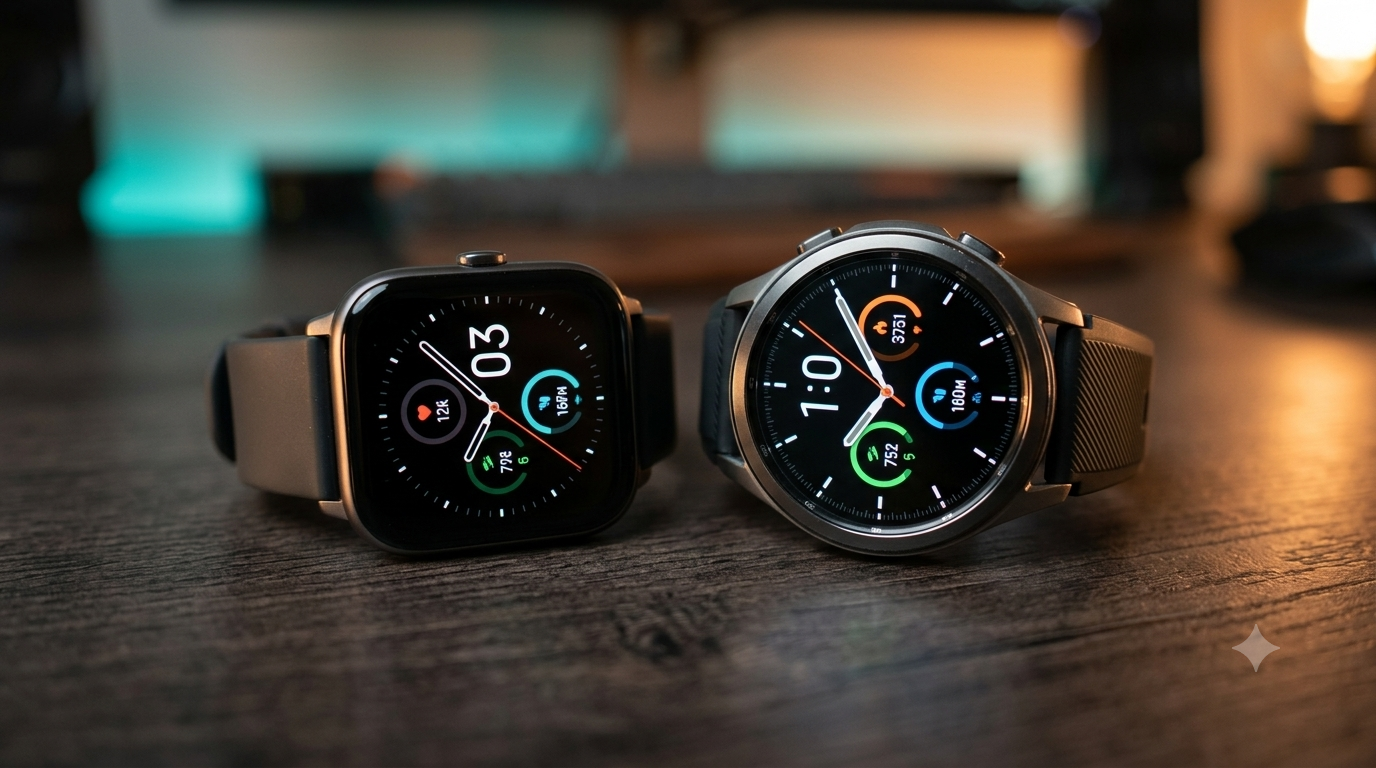

Walk into the budget wearable market under ₹2,500 in 2026, and every retail box greets you with identical, bold marketing claims: Ultra-HD AMOLED Display, Crystal Clear Bluetooth Calling, 7-Day Battery Life!
Once the device is strapped to your wrist, real-world conditions tell a different story. In direct afternoon sunlight, many budget screens wash out completely. When taking a call on a moving two-wheeler or in traffic, the microphone often captures more wind noise than your voice. Turn on the Always-On Display (AOD), and the supposed seven-day battery drains before dinner.
Component manufacturing costs have dropped significantly in 2026, making true AMOLED panels accessible at budget price points. However, not every budget AMOLED smartwatch is built to last. We evaluated the top three contenders under real conditions—direct outdoor sunlight, active Bluetooth calling, and continuous daily wear—to find which watches deliver genuine value for ₹2,500.
True AMOLED vs. Marketing TFT: Why Panel Quality Matters
At this price point, several brands rebrand high-brightness TFT or IPS panels as “AMOLED-grade” or “Super Retina.” A genuine AMOLED (Active Matrix Organic Light Emitting Diode) panel delivers three specific functional advantages:
- Individual Pixel Shutoff (True Deep Blacks): Because AMOLED pixels emit their own light, black areas are completely turned off. This blends screen borders seamlessly with dark bezels and cuts power consumption when using dark watch faces.
- True Always-On Display (AOD): You can check the time continuously without having to flick your wrist aggressively or press physical buttons.
- High Peak Nit Brightness: Authentic AMOLED panels in this category reach between 650 and 850 nits of peak brightness, keeping notifications and caller IDs legible under direct sunlight.
Top 3 AMOLED Smartwatches Under ₹2,500: Hands-On Assessment
1. Noise ColorFit Pro 5 Max / Pulse 3 AMOLED — The Best All-Round Daily Driver
Noise continues to dominate this segment due to refined software optimization, dependable smartphone connectivity, and reliable build quality.
- Display: 1.96-inch AMOLED (60Hz Refresh Rate, 800 nits Peak Brightness)
- Chassis & Build: Metallic-finish polycarbonate casing, silicone strap, IP68 water resistance
- Battery Specs: 300 mAh (Up to 5 days standard usage; 1.5 to 2 days with AOD enabled)
Real-World Testing Notes:
- Calling & Audio Quality: Features single-chip Bluetooth calling with an integrated ENC (Environmental Noise Cancellation) mic algorithm. In moderate office noise or indoor environments, speech transmission is crisp. In heavy traffic, callers noted minor suppression artifacts, but conversations remained completely intelligible.
- Display Performance: The 60Hz refresh rate eliminates the interface stutter common on entry-level smartwatches. Colors are punchy, and touch input latency is negligible.
- Drawbacks: When Always-On Display is kept running from morning to night, the battery requires recharging roughly every 36 to 40 hours.
2. boAt Lunar Orbit / Wave Sigma AMOLED — Loud Speaker & Bold Design
If you prioritize high-volume speaker output for answering quick calls while working at a desk or listening to voice notes on the go, boAt delivers substantial volume.
- Display: 1.85-inch 2.5D Curved AMOLED (700 nits Peak Brightness)
- Chassis & Build: Zinc-alloy decorative bezel, soft-touch silicone strap
- Battery Specs: 280 mAh (Up to 4 days standard usage; ~1.5 days with AOD)
Real-World Testing Notes:
- Calling & Audio Quality: The speaker output is roughly 15–20% louder than competitors in this bracket. You will rarely miss an incoming ring. However, pushing the volume to 100% introduces noticeable harmonic distortion on higher frequencies.
- Fitness Tracking & Sensor Reliability: Step counting algorithms run slightly sensitive; regular vehicle travel on bumpy roads can record false step counts of 100–250 steps.
- Drawbacks: The companion app occasionally drops background sync permissions on aggressive battery-saving Android skins (MIUI/ColorOS), requiring manual app relaunching.
3. Fastrack Limitless FS1 Pro — Sporty Aesthetics & Fast Connectivity
Targeted at college students and fitness enthusiasts, Fastrack provides clean aesthetics paired with a stable, clutter-free user interface.
- Display: 1.91-inch Super AMOLED (UltraVue Display, 750 nits)
- Chassis & Build: Dual-tone sporty rectangular case, sturdy metal pin buckle
- Battery Specs: Up to 4.5 days regular usage; up to 2 days with AOD
Real-World Testing Notes:
- Calling & Audio Quality: Built on an optimized chipset platform that establishes Bluetooth connections instantly when powered on. Call drop rates over a test week were virtually zero within standard room range (8–10 meters).
- Interface & Usability: The watch UI is clean, without unnecessary bloatware or unskippable animations. Notification syncing for WhatsApp and messaging apps handles emojis and multi-line previews smoothly.
- Drawbacks: The companion app offers fewer community watch face customization options compared to Noise.
Head-to-Head Specification & Performance Comparison
| Feature | Noise ColorFit AMOLED | boAt Lunar Orbit AMOLED | Fastrack Limitless FS1 Pro |
|---|---|---|---|
| Display Size | 1.96-inch AMOLED | 1.85-inch AMOLED | 1.91-inch Super AMOLED |
| Peak Brightness | ~800 nits | ~700 nits | ~750 nits |
| Refresh Rate | 60Hz | 45–60Hz | 60Hz |
| Calling Clarity | 8.5 / 10 (Clean voice tuning) | 8.0 / 10 (High volume output) | 8.5 / 10 (Stable Bluetooth 5.3) |
| AOD Battery Life | 1.5 – 2 Days | ~1.5 Days | ~2 Days |
| Sensor Precision | 8.0 / 10 | 7.0 / 10 | 8.0 / 10 |
| Water Protection | IP68 Certified | IP68 Certified | IP68 Certified |
| Approx. Street Price | ₹2,299 – ₹2,499 | ₹1,999 – ₹2,199 | ₹2,399 – ₹2,499 |
What Brands Don’t Tell You: 3 Realities of Sub-₹2,500 Smartwatches
Before finalizing a purchase, understand the realistic boundaries of entry-level wearable hardware:
- Sensors Are Indicative, Not Medical-Grade: Optical PPG sensors for heart rate (BPM) and blood oxygen (SpO2) provide general trend tracking during workouts. They lack FDA/CDSCO clinical validation and should never be relied upon for critical medical assessments.
- The Always-On Display Battery Tax: A manufacturer’s headline “7-Day Battery” specification is calculated with AOD turned off, brightness lowered to 40%, and continuous heart-rate monitoring disabled. Running continuous health tracking with an active AOD cuts uptime to roughly 36–48 hours across all brands.
- Water Resistance Limitations: An IP68 certification protects against accidental rain, sink splashes, and workout sweat. It does not certify protection against high-velocity tap water, hot showers (steam damages rubber gaskets), or chlorinated swimming pools.
Final Verdict: Which Smartwatch Should You Buy?
- Choose the Noise ColorFit Series if you want the sharpest 60Hz display, clean aesthetic framing, and the most reliable all-round calling performance.
- Choose the boAt Lunar Orbit if you require the loudest ringtone and call audio output under a strict ₹2,000 threshold.
- Choose the Fastrack Limitless FS1 Pro if you prefer a sporty silhouette, proven brand longevity, and reliable Bluetooth auto-reconnect speeds.
Frequently Asked Questions (FAQs)
Q1. Can you read these AMOLED displays clearly under direct Indian sunlight?
Yes. Smartwatches boasting 700 to 800 nits of peak brightness remain legible under harsh direct sunlight for reading notifications, checking caller IDs, and tracking step metrics.
Q2. Can I answer calls directly without picking up my smartphone?
Yes. As long as your smartwatch stays within active Bluetooth range (approximately 10 meters / 33 feet) of your smartphone, you can accept, reject, or place calls directly through the watch’s integrated microphone and speaker.
Q3. Does keeping Always-On Display (AOD) on cause screen burn-in on budget watches?
Modern budget AMOLED panels utilize subtle pixel-shifting software to move clock hands and digits periodically across idle frames, minimizing permanent OLED burn-in during standard everyday use.