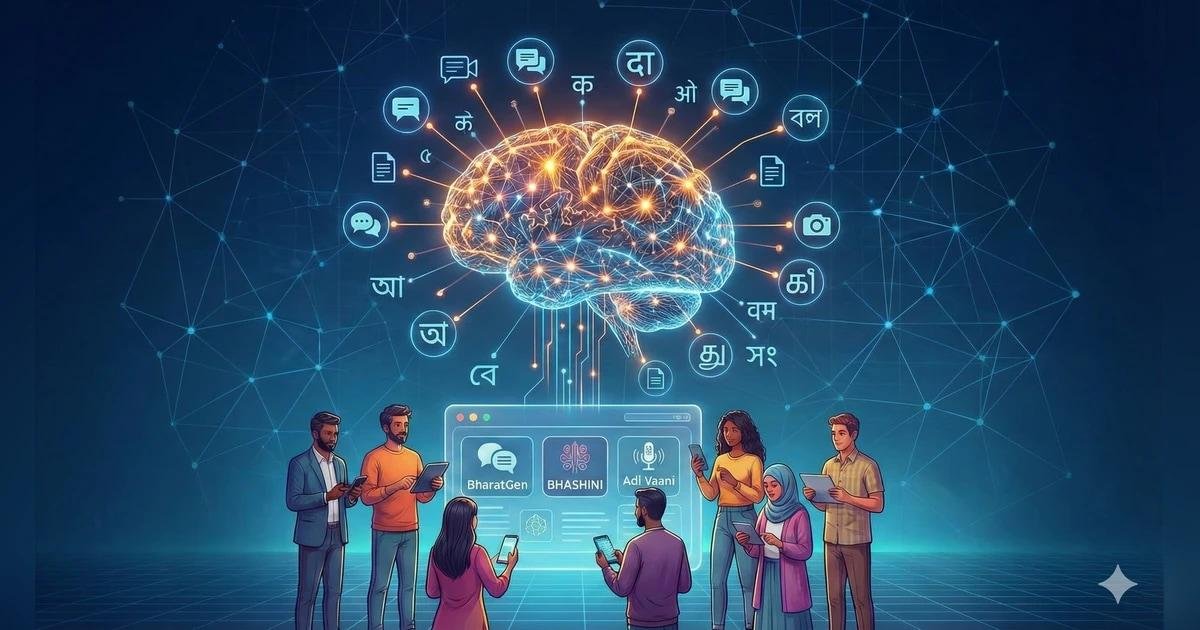

India has taken another important step in artificial intelligence development with the release of three homegrown AI models under the government’s IndiaAI Mission.
On November 3, 2026, the Ministry of Electronics and Information Technology (MeitY) announced the release of EKA-1, Dhīr 2B and Dhīr 5B. These models were developed by Indian technology companies Soket Labs Technology and Research Private Limited and ZenteiQ AiTech Innovations.
Unlike AI services that depend entirely on large cloud platforms, the new models are designed for different requirements, including multilingual communication, coding, reasoning, document processing and secure deployment.
One particularly interesting development is that the smaller Dhīr models are designed for offline-capable and on-device use, including deployment on supported mobile hardware.
Here is what we know about India’s three new AI models, their features and what they could mean for smartphone users, businesses and developers.
What Are India’s Three New AI Models?
The IndiaAI Mission has introduced three models with different capabilities and intended use cases.
| AI Model | Developer | Main Purpose |
|---|---|---|
| EKA-1 | Soket Labs | Mathematics, coding, reasoning and agentic AI |
| Dhīr 2B | ZenteiQ | Lightweight multilingual AI assistance |
| Dhīr 5B | ZenteiQ | More capable multilingual AI assistance |
These models were developed under the IndiaAI Innovation Centre’s Foundation Models initiative.
The government says they are intended to support India’s domestic AI ecosystem and provide technology suited to different requirements, from advanced reasoning to secure offline applications.
1. EKA-1: A 26.3-Billion-Parameter Indian AI Model
EKA-1 is developed by Soket Labs Technology and Research.
According to the official announcement, the model features 26.3 billion parameters and was trained on approximately 7.5 trillion tokens.
Its capabilities include:
- Mathematics and problem-solving.
- Programming and code-related tasks.
- Advanced reasoning.
- Multilingual AI applications.
- Agentic AI use cases.
One of its important features is language coverage.
EKA-1 supports all 22 scheduled Indian languages alongside English. This could make it useful for applications that need to understand India’s diverse language requirements.
The developer has also described its potential for specialised applications in areas such as banking, financial services and cybersecurity.
However, the model’s parameter count and training data alone do not establish that it performs better than other leading AI systems. Independent performance evaluations will be important for understanding its actual capabilities.
2. Dhīr 2B and Dhīr 5B: AI Designed for Offline Use
The second development comes from ZenteiQ AiTech Innovations, which introduced two open-source models: Dhīr 2B and Dhīr 5B.
These models are designed as multilingual assistants that can support English and 10 Indian languages.
Their main focus is secure deployment, document-based assistance and applications where internet connectivity may be limited.
The official announcement highlights several capabilities:
- Document-grounded automation.
- Information retrieval from documents.
- Multilingual assistance.
- Enterprise and government applications.
- Offline-capable deployment.
- On-premise use in sensitive environments.
ZenteiQ says these models can be deployed across different computing platforms, including GPUs and TPUs. The company also describes their potential for on-device deployment on supported mobile hardware.
This could be useful for applications where users need access to AI features without continuously sending their information to an external cloud service.
However, actual offline performance will depend on the device’s hardware, memory, software optimisation and the specific model deployment.
Can Dhīr AI Work on a Smartphone Without Internet?
This is one of the most interesting possibilities behind the new announcement.
Many popular AI assistants rely on cloud servers. When users ask a question, their request is sent over the internet to remote infrastructure, where the model processes it and returns a response.
On-device AI works differently.
A compatible model can run locally on a supported device. This can reduce dependence on internet connectivity and may help keep certain data on the device.
Dhīr 2B and Dhīr 5B are designed with this type of deployment in mind.
Potential uses include:
- Asking questions about stored documents.
- Getting assistance with notes and information.
- Searching local knowledge resources.
- Using multilingual AI features in low-connectivity environments.
- Supporting private enterprise applications.
It is important to understand that the announcement does not mean every Android smartphone can immediately download and run these models.
Device compatibility, memory requirements, model availability and installation instructions need to be confirmed before ordinary users can use them.
Why Is Offline AI Important?
Offline AI could make a meaningful difference in situations where internet access is unreliable or sensitive information should remain within an organisation’s infrastructure.
Consider a few examples.
Students
Students could potentially use local AI tools to understand study material, search documents and receive explanations without depending on a constant internet connection.
Businesses
Companies handling confidential documents may prefer AI systems that can run within their own infrastructure.
Government departments
Sensitive departments may require systems that operate in restricted environments without direct internet access.
Rural and low-connectivity areas
Offline-capable AI could help bring digital assistance to locations where internet connectivity is unreliable.
These are potential applications, not a guarantee that every use case is already available in a finished consumer product.
EKA-1 vs Dhīr 2B vs Dhīr 5B
The three models have different design goals.
| Feature | EKA-1 | Dhīr 2B | Dhīr 5B |
|---|---|---|---|
| Developer | Soket Labs | ZenteiQ | ZenteiQ |
| Parameters | 26.3B | 2B | 5B |
| Language support | 22 Indian languages + English | 10 Indian languages + English | 10 Indian languages + English |
| Main focus | Reasoning, maths, coding, agentic use | Lightweight AI assistance | Multilingual AI assistance |
| Offline deployment | Depends on deployment | Designed for offline-capable use | Designed for offline-capable use |
| Open-source status | See official release details | Open-source | Open-source |
The parameter figures are not a direct measure of real-world quality. Actual performance depends on architecture, training, hardware and evaluation results.
How Could These Models Affect India’s AI Industry?
India has a large technology sector, a diverse language environment and growing demand for AI applications.
Homegrown foundation models could help developers build products for Indian users without relying exclusively on overseas AI platforms.
The models may also support specialised solutions in:
- Education and research.
- Banking and financial services.
- Government services.
- Cybersecurity.
- Industrial automation.
- Multilingual customer support.
The IndiaAI Mission has supported selected teams through access to subsidised national AI computing infrastructure and research assistance.
This support is part of a wider effort to develop domestic AI capabilities.
Where Can Developers and Researchers Access These Models?
The Ministry’s announcement identifies AIKosh as a platform through which models and related resources can be made accessible to researchers, students, innovators and the wider public.
Interested users should check the official platform for model availability, documentation, licences and supported deployment instructions.
Do not assume that every model is already available as a simple smartphone application. Access to model weights and technical deployment resources is different from having a ready-to-use consumer app.
What Should Smartphone Users Expect?
For ordinary smartphone users, the biggest opportunity is the possibility of more AI features running directly on compatible devices.
If local AI deployment becomes practical, users could eventually benefit from:
- AI assistance with less dependence on internet connectivity.
- Faster responses for certain local tasks.
- Better control over where personal documents are processed.
- More multilingual applications.
- New AI features from Indian developers.
But these benefits will depend on actual implementations. The announcement does not confirm a launch date for a dedicated Dhīr smartphone app or universal Android support.
Final Verdict
The release of EKA-1, Dhīr 2B and Dhīr 5B is an important development for India’s artificial intelligence ecosystem.
EKA-1 focuses on advanced reasoning, mathematics, coding and agentic applications across India’s scheduled languages. Dhīr 2B and Dhīr 5B focus on multilingual assistance, document-based tasks and secure, offline-capable deployment.
The most interesting possibility for consumers is on-device AI. If these models are successfully optimised for supported smartphones and other hardware, they could help developers build useful AI experiences with less dependence on cloud connectivity.
For now, the next important step is wider availability, transparent technical documentation and independent performance testing.
India’s homegrown AI journey is progressing, and these three models add another important chapter.
Frequently Asked Questions
1. Which three AI models has India released in November 2026?
The IndiaAI Mission released EKA-1 by Soket Labs and Dhīr 2B and Dhīr 5B by ZenteiQ AiTech Innovations on November 3, 2026.
2. What is EKA-1 AI?
EKA-1 is a 26.3-billion-parameter foundation model developed by Soket Labs. It was trained on approximately 7.5 trillion tokens and supports all 22 scheduled Indian languages alongside English.
3. Can Dhīr AI work without the internet?
Dhīr 2B and Dhīr 5B are designed for offline-capable deployment. Actual offline use depends on compatible hardware, software and the availability of the required model files.
4. Can Dhīr AI run on Android smartphones?
The developer describes on-device deployment on supported mobile hardware. However, this does not mean that every Android smartphone is compatible. Hardware requirements and deployment instructions need to be checked.
5. Which Indian languages do the new AI models support?
EKA-1 supports all 22 scheduled Indian languages alongside English. Dhīr 2B and Dhīr 5B support English and 10 Indian languages.
6. Who developed EKA-1 and Dhīr AI?
Soket Labs Technology and Research Private Limited developed EKA-1. ZenteiQ AiTech Innovations developed Dhīr 2B and Dhīr 5B.
7. Are Dhīr 2B and Dhīr 5B open-source?
Yes. The official MeitY announcement describes both Dhīr models as open-source. Developers should check the official model release for the applicable licence and usage conditions.
8. Where can I find India’s new AI models?
The government has identified AIKosh as an access platform for researchers, students, innovators and the wider public. Check its official catalogue for current model files and documentation.
This article is based on the official government announcement. Product availability, hardware compatibility and independent model performance may change as technical documentation and deployment options are released.