
Introduction
Let’s be honest: thinking about home security can feel overwhelming. A few years ago, setting up CCTV meant drilling holes, running thick wires, and buying expensive recording boxes (DVRs) that sat gathering dust in a corner.
Fast forward to 2026, and you can secure your entire home, keep an eye on your pets, or check on your kids, all for less than the price of a fancy dinner—under ₹2,000, to be exact.
But with so many brands claiming to be the “best,” how do you know which one won’t die on you after three months? We went ahead and looked closely at the most popular budget Wi-Fi cameras on the market to tell you what’s actually worth your hard-earned money and where the catch lies.
Let’s dive into the four best budget security cameras you can buy right now.
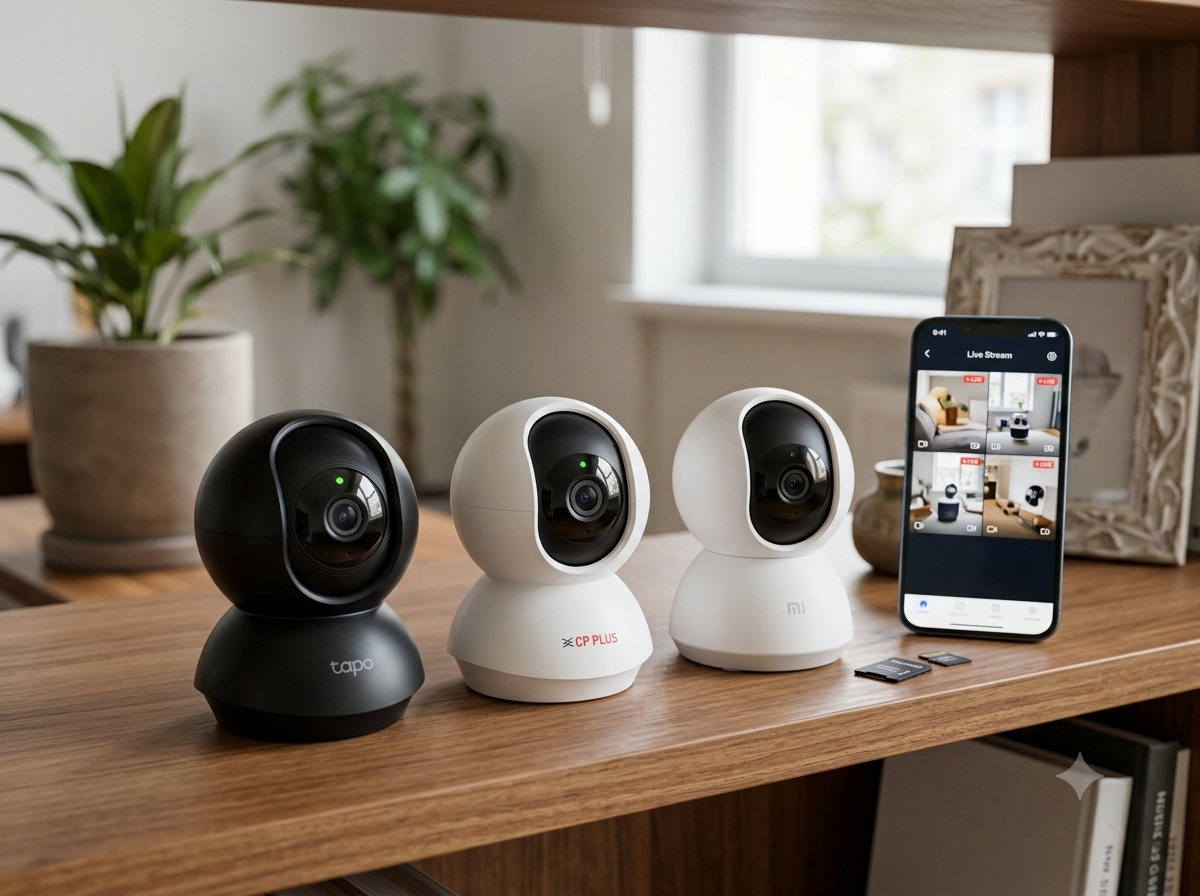
Quick Comparison: Top Wi-Fi Cameras Under ₹2,000
| Camera Model | Video Resolution | Field of View | Storage Support | Best For |
|---|---|---|---|---|
| TP-Link Tapo C200 | 1080p Full HD | 360° Horizontal | Up to 128GB MicroSD | All-round reliability |
| CP PLUS 3 MP | 1296p (3MP) | 360° Pan & Tilt | Up to 128GB MicroSD | Best picture clarity |
| Xiaomi Mi Home 2i | 1080p Full HD | 360° Horizontal | Up to 64GB MicroSD | Smart AI features |
| Realme Smart Cam 360° | 1080p Full HD | 360° Horizontal | Up to 128GB MicroSD | Low-light night video |
1. TP-Link Tapo C200: The No-Nonsense Reliable Choice
If you ask anyone in the tech community for a budget camera recommendation, the Tapo C200 is usually the first name you’ll hear. It’s not the fanciest, but it’s a workhorse.
- The Good Stuff: First off, it’s incredibly easy to set up. The Tapo app is super smooth and rarely lags, which is a massive plus when you’re trying to check a live feed quickly. The 1080p video is clear enough to recognize faces, and the 360-degree pan-and-tilt motion works without any squeaking or stuttering.
- Safety Features: It has a built-in siren and light alarm. If you’re away and it detects movement where there shouldn’t be any, it can make quite a racket to scare off intruders.
- The Catch: While the night vision is decent (up to 30 feet), it can sometimes get a little grainy if the room is completely pitch black and spacious. Also, keep in mind that the power cord is on the shorter side, so you might need an extension if you are mounting it high on a wall.
2. CP PLUS 3 MP Wi-Fi Camera: Extra Sharpness on a Budget
CP PLUS is a giant in the CCTV world, and they’ve brought their expertise down to this budget consumer model.
- The Good Stuff: Unlike most cameras in this price bracket that stop at 2MP (1080p), CP PLUS gives you a 3MP sensor. It’s a noticeable jump—everything looks just a bit sharper, making it easier to read text or zoom in without the picture turning into a blur of pixels. It also has a clever ‘Motion Tracking’ feature that actually follows a person as they walk across the room.
- Privacy Mode: A really thoughtful addition is the privacy mode. Tap a button in the app, and the lens physically rolls downward into its casing so you know for sure it isn’t watching you when you’re just lounging around.
- The Catch: The CP PLUS app can occasionally feel a bit cluttered compared to TP-Link’s, and the motion alerts can sometimes be oversensitive, buzzing your phone over a fluttering curtain unless you tweak the settings.
3. Xiaomi Mi Wireless Home Security Camera 2i: The Smart Thinker
Xiaomi is known for packing smart features into cheap devices, and the 2i camera is no exception. It’s sleek, looks like a little sci-fi robot, and tries to be smarter than the rest.
- The Good Stuff: The standout feature here is the AI Human Detection. Cheaper cameras often spam your phone with notifications every time a shadow changes or a fly zooms past the lens. Xiaomi’s algorithm is pretty good at ignoring the junk and only alerting you when it detects an actual human shape.
- Bandwidth Saver: It uses newer video compression (H.265) which means your recorded video takes up way less space on your MicroSD card and uses less of your internet bandwidth when you’re viewing the live feed on mobile data.
- The Catch: Xiaomi has capped the external storage support at 64GB. That’s a bit disappointing when almost every competitor under ₹2,000 supports up to 128GB. If you want continuous recording, you’ll have to back it up or clear the card more often.
4. Realme Smart Cam 360°: Built for Dark Rooms
Realme entered the smart home space recently, and they’ve done a great job targeting some of the overlooked pain points of indoor cameras, particularly low-light performance.
- The Good Stuff: If you need a camera for a poorly lit basement, garage, or a room with the blinds always drawn, this is your best bet. Its 3D noise reduction does a fantastic job of smoothing out the video in low-light conditions, keeping the footage usable when others might just show a grainy mess.
- Warp-Free Video: Many budget 360 cameras distort the edges of the image (making it look like a fishbowl). Realme has built-in correction that keeps the lines of your walls and furniture looking natural and flat.
- The Catch: Setup can sometimes be a bit of a headache if your Wi-Fi is on a combined 2.4GHz and 5GHz band—it strictly requires 2.4GHz (like most cameras, but Realme can be extra picky during the initial pairing process).
Real-Talk Buying Advice: Don’t Fall for the Marketing Hype
Before you add any of these to your cart, here is some honest advice to save you frustration later:
- Don’t ignore your Wi-Fi: These cameras are useless without a stable 2.4GHz Wi-Fi signal. If you place a camera in a dead zone of your house, the feed will constantly drop, regardless of how expensive the camera was.
- Buy the SD card separately: Do not buy the bundles that include a MicroSD card unless it’s a known brand (SanDisk, Samsung). Cheap, unbranded SD cards will corrupt quickly, and you might find your camera hasn’t been recording for weeks without you knowing.
- Remember the Power: These are NOT battery-powered. You will need to plug them into a standard wall socket, so plan your mounting location near a power source.
Frequently Asked Questions (FAQs)
Q1: Do these cameras require a monthly subscription?
No, thankfully. While all these brands will try to sell you their “Cloud Storage” subscriptions to save videos online, you can absolutely ignore them. Just pop in a MicroSD card, and you can record, play back, and view everything for free.
Q2: Can I use these cameras outside?
Short answer: No. None of the cameras on this list are weatherproof. They don’t have water or dust resistance (IP rating). If you place them under direct rain or too much dust, they will fail. If you must use them outdoors, make sure they are completely sheltered under a deep balcony or shed.
Q3: What happens if someone steals the camera? Will I lose my footage?
Yes, if someone physically rips the camera off the wall and takes it, they take your MicroSD card and your recorded footage with it. To prevent this, mount the camera high enough so it’s out of easy reach, or consider turning on motion detection alerts so you instantly get a clip sent to your phone before anyone can touch it.
Q4: Will it work during a power outage?
No. Since these cameras rely on a constant wall outlet for power, they will turn off if your electricity goes out. If you have frequent power cuts, consider plugging the camera into your home UPS or a power bank (yes, some can run off a standard power bank in an emergency!).
Q5: How many days of footage can I fit on a 128GB card?
If you have it set to continuous 1080p recording, a 128GB card will easily give you around 10 to 14 days of footage. Once it’s full, it won’t stop; it will simply delete the oldest day to make room for the new one (loop recording).
Q6: Can I watch the video on my phone when I am in another city?
Absolutely. As long as the camera at home is connected to your house Wi-Fi, and your phone has any mobile data or internet connection, you can watch the live feed, hear audio, and rotate the camera from anywhere in the world.