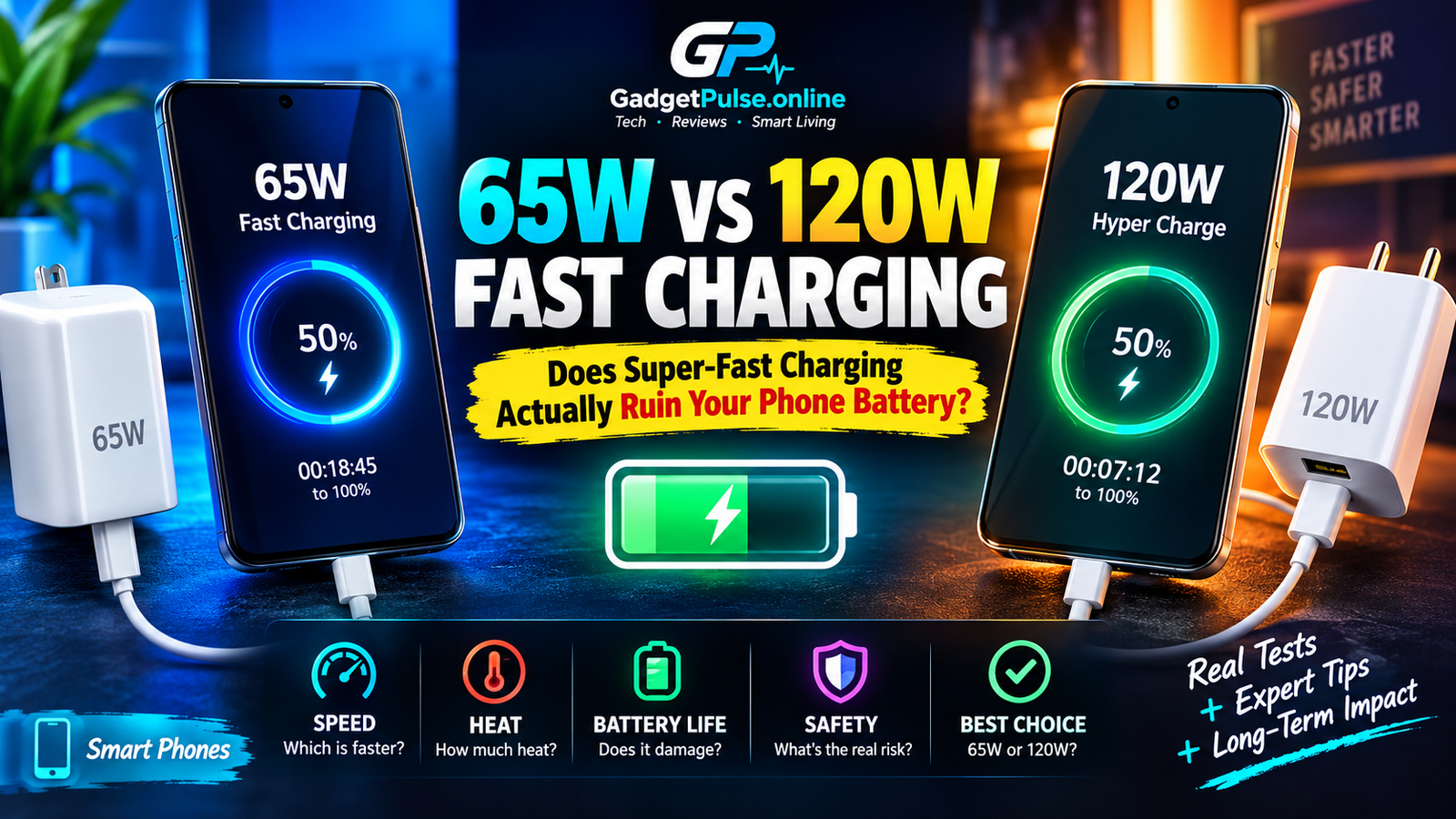

Remember when charging a phone meant plugging it in before bed and hoping it would be ready by morning? Things have changed. Today, some smartphones can recharge in a fraction of that time, thanks to 65W, 67W, and even 120W fast-charging technology.
It sounds impressive, especially when you are rushing out of the house with only 10 minutes to spare. But there is one question many smartphone users still have: Does 120W fast charging damage your battery faster than 65W charging?
The honest answer is that it depends on the phone, its battery design, temperature, and charging system. Higher wattage is not automatically bad for your battery, but heat and the way you charge your phone can make a real difference over time.
Let’s look at what actually matters before you decide which charging speed is right for you.
How Does Fast Charging Actually Work?
First, a quick clarification: a 120W charger does not continuously send 120 watts into your phone from 0% to 100%.
The phone and charger communicate with each other, and the phone’s charging system controls how much power the battery receives. The maximum power also depends on the charger’s compatibility, cable, battery temperature, and current charge level.
Charging generally works in stages:
- When the battery is low: A compatible phone can accept relatively high charging power, allowing the battery percentage to rise quickly.
- As the battery fills up: The charging system gradually reduces power to manage temperature and protect the battery.
- Near 100%: Charging slows considerably, and the phone manages the final stage to avoid unnecessary stress.
This is why a phone may reach 50% surprisingly quickly but take considerably longer to complete the remaining charge.
If you are planning to buy a new device, our smartphone buying guide can help you compare features that matter beyond charging speed.
65W vs 120W Fast Charging: What’s the Difference?
The biggest difference is how quickly a compatible phone can recharge under suitable conditions. However, the advertised wattage alone does not tell you the whole story.
1. 65W or 67W Fast Charging
For many people, 65W charging offers a practical balance between convenience and charging speed.
What you can expect:
- Faster charging than many conventional chargers.
- Enough power for quick top-ups during a busy day.
- Potentially less heat than a comparable 120W system, although this depends on the phone’s design.
- Plenty of convenience without necessarily needing the highest advertised charging speed.
A phone with a 5,000mAh battery might take around 35–50 minutes to charge fully with some 65W systems. That is only an illustration, not a universal benchmark. Actual charging times vary by model and conditions.
2. 120W or 125W Fast Charging
If you regularly forget to charge your phone overnight, 120W charging can be genuinely useful.
A compatible smartphone may recharge much faster than a 65W model, particularly when the battery is low. Some devices advertise a full charge in roughly 20 minutes, but real-world results depend on the manufacturer’s charging system and test conditions.
What you should know:
- Short charging sessions can be much more convenient.
- Heat management becomes especially important.
- The phone may reduce charging speed when its battery gets warm.
- You need a compatible charger and cable to achieve the advertised speed.
A 120W charger is not automatically better than a 65W charger. If both phones meet your daily needs, the difference in charging convenience may not justify choosing one device over another.
Does 120W Fast Charging Actually Ruin Your Battery?
No, not automatically. Modern smartphones are designed with charging controls and temperature monitoring, but all rechargeable lithium-ion batteries gradually lose capacity with use.
The important distinction is between normal battery ageing and additional wear caused by unfavourable charging conditions.
Heat is one of the factors that can accelerate battery degradation. Keeping a battery at a high charge level for extended periods can also contribute to ageing. Fast charging may increase heat generation, but the effect depends on how the manufacturer has designed the charging system.
Why Some 120W Phones Use Dual-Cell Batteries
Some manufacturers use a dual-cell design instead of a single battery cell. This allows the charging system to distribute power across two cells and can help achieve very high charging speeds.
However, dual-cell batteries do not eliminate heat or guarantee a longer battery lifespan. The complete design, including power management and thermal controls, still matters.
Manufacturers may also use temperature sensors and charging software to reduce power when necessary.
What About Battery Health After Two Years?
You may see claims that a phone will retain a particular percentage of battery capacity after a fixed number of charging cycles. Be careful with such claims.
Battery lifespan varies by device, usage, temperature, charging habits, and the manufacturer’s testing method. Without reliable test data for a specific model, it would be misleading to promise that a 120W phone will retain 80% battery health after a particular number of cycles.
If your battery is losing charge unusually quickly, fast charging may not be the only explanation. Background apps, weak mobile signals, screen brightness, and software problems can also contribute.
Our guide on why your Android battery drains so fast explains what to check before blaming the charger.
Which Should You Choose: 65W or 120W?
The right choice depends on your daily routine, not just the number printed on the charger.
Choose a 65W or 67W phone if:
- You usually charge your phone while getting ready in the morning.
- You want fast charging without paying extra just for a higher wattage rating.
- You plan to keep your phone for several years and care about long-term battery health.
- The phone’s overall features matter more to you than saving a few minutes during charging.
Choose a 120W phone if:
- You regularly need a quick recharge before leaving home.
- You travel frequently or have a busy schedule.
- The phone has a well-designed charging system and good thermal management.
- Fast charging is a feature you will genuinely use.
My practical advice? Don’t choose a smartphone based on charging wattage alone. Battery capacity, real-world endurance, software support, repair costs, and charging performance all deserve consideration.
5 Charging Habits That Can Help Your Battery Last Longer
You don’t need to obsess over every percentage point. A few sensible habits can help reduce unnecessary battery stress.
1. Avoid Heavy Gaming While Charging
Gaming generates heat inside the phone. Charging at the same time can add more heat, particularly with demanding games and high-power charging.
If your phone becomes noticeably hot, take a break and let it cool down.
2. Don’t Worry About Reaching Exactly 20% Every Time
Lithium-ion batteries do not need to be completely discharged before recharging.
Frequent deep discharges can contribute to battery wear. Charging when convenient and avoiding repeated trips to 0% is a sensible approach.
Keeping the battery roughly between 20% and 80% can help reduce stress if it fits your routine. However, charging to 100% when you need the extra capacity is perfectly reasonable.
3. Use a Compatible, Reliable Charger
Use the manufacturer’s charger when practical, or a reputable third-party charger that supports your phone’s charging standard.
Check cable quality and compatibility too. An incompatible charger may not deliver the advertised speed, and poor-quality charging accessories can create safety risks.
4. Keep Your Phone Cool While Charging
Avoid charging under a pillow, inside thick bedding, or in direct sunlight.
A hard, stable surface that allows heat to escape is a better choice. If the phone repeatedly becomes excessively hot, disconnect it and investigate the cause.
5. Use Battery Protection Features
Many smartphones offer features such as Optimised Charging, Adaptive Charging, a charging limit, or a battery protection mode.
Depending on the device, these features can help reduce the time the battery spends at a high charge level. Check your phone’s settings and use the options available for your model.
You do not necessarily need to disable fast charging every night. A supported battery protection feature is often a more convenient starting point.
Final Verdict: Is 120W Charging Worth It?
For most users, both 65W and 120W charging can be sensible choices when properly implemented by the phone manufacturer.
The 120W option is attractive if you frequently need a quick top-up. Meanwhile, 65W is already fast enough for many everyday charging needs.
What matters most is how well the phone manages heat, whether you use compatible charging accessories, and how you treat the battery over time.
Here is the bottom line: Buy 120W charging for the convenience if you need it, not because a bigger number automatically means better technology. And if your phone supports 65W, there is no need to feel that you are missing out.
A well-designed 65W phone can be a better choice than a poorly implemented 120W phone. Look at the complete device before making your decision.
Last updated: October 2026
Frequently Asked Questions
1. Can I use a 120W charger with a phone that supports only 65W?
Generally, yes, provided the charger is reputable and compatible with your phone’s charging protocol. The phone normally negotiates the power it can accept, so it will not automatically receive 120W. However, compatibility affects charging speed, and not every charger supports every manufacturer’s proprietary fast-charging system.
2. Is it normal for a phone to get warm while charging?
Yes. Some warmth is normal, especially during fast charging. However, excessive heat, repeated temperature warnings, swelling, or unusual smells should not be ignored. Disconnect the charger if the device becomes dangerously hot, and seek professional assistance when necessary.
3. Should I charge my phone to 100% every day?
You can charge it to 100% when you need the extra battery life. If your phone offers an 80% charging limit or optimised charging, using it may help reduce long-term battery wear. There is no need to follow a strict 20–80% rule if it makes everyday use inconvenient.
4. Is wireless charging worse for battery health than wired charging?
Not necessarily. Wireless charging can produce additional heat because energy transfer is less efficient, but the result depends on the charger, phone design, alignment, and cooling system. A well-designed wireless charging system can manage temperature effectively.
5. Is overnight charging safe with a modern smartphone?
Modern smartphones manage charging electronically and are designed to prevent ordinary overcharging. Still, keeping a battery at a high charge level for long periods can contribute to ageing. Use a suitable charger, avoid trapping heat, and enable optimised charging if your phone supports it.
6. Does using a slower charger improve battery life?
A slower charger may reduce heat in some circumstances, but the difference depends on the phone and charging conditions. Temperature management and time spent at a high charge level also matter. A slower charger is not a guarantee of better battery health.